Rules & scoring
How points are awarded, and how the squad, captain, transfers and Boosts work – in the unofficial fantasy game for the Swiss Super League.
Last updated: 27 July 2026
Matchday Manager Switzerland is a fantasy football game for the Swiss top league: you build a squad of real players, pick a starting XI Round after Round and score points for what your players do on the pitch. This page explains in full how those points are awarded, and how the squad, the lineup, transfers, Boosts and prices fit together.
Squad & budget
Your squad is 15 players. The split is fixed — these are not minimums or maximums, they are exactly the numbers:
- 2 goalkeepers
- 5 defenders
- 5 midfielders
- 3 forwards
To assemble them you have a starting budget of 100.0 million CHF. Every player has a price; whatever is left once the squad is built becomes your bank and stays there for future transfers. You do not have to spend the whole budget, but you can never exceed it — not when you build, and not later.
One more limit applies at all times: a maximum of 3 players from any one club. It is checked when you build the squad and again on every single transfer.
The price you pay for a player is recorded. That purchase price is what decides how much you get back when you sell him — see Prices.
Lineup & formations
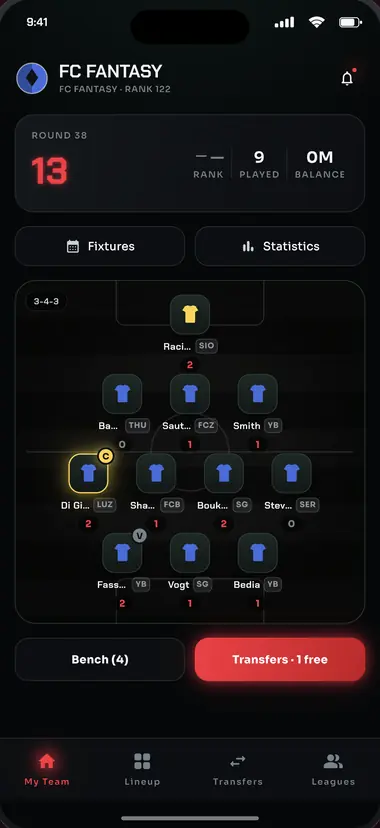
Before every Round you pick 11 starters from your 15 players; the other 4 sit on the bench. Only starters score. A bench player counts only if he comes on through an auto-sub — or if you play the Bench Boost.
Valid formations
There is always exactly one goalkeeper in the starting XI. For the outfield players the limits are:
- Defence: 3 to 5
- Midfield: 2 to 5
- Attack: 1 to 3
That gives exactly eight possible formations: 3-4-3, 3-5-2, 4-3-3, 4-4-2, 4-5-1, 5-2-3, 5-3-2 and 5-4-1. They are always written defence-midfield-attack; the goalkeeper is implied. You can change formation as often as you like up to the deadline.
The bench
The four bench places each have a job. One is reserved for the substitute goalkeeper; the other three are numbered 1, 2 and 3 and hold outfield players. Those numbers are the substitution order — number 1 comes on first, then 2, then 3. You set that order yourself, and it is one of the few settings that can still swing a quiet Round.
Auto-subs
If a starter does not play, the bench steps in automatically. An auto-sub only happens when all of the following hold:
- The starter's match is over and he played 0 minutes. Nothing happens while his match is still to come or still in progress.
- The bench is worked through in order: the substitute goalkeeper first, then 1, then 2, then 3.
- A bench player is only eligible if he played himself — at least one minute on the pitch.
- A goalkeeper can only replace a goalkeeper, and an outfield player can only replace an outfield player.
- The formation must still be valid after the swap.
The first bench player who satisfies all of it comes on. Each bench player can only come on once per Round.
Why sometimes nobody comes on. Take a 5-4-1: your lone striker does not play. A defender cannot replace him — that would be 6 defenders, and 5 is the maximum. Nor can a midfielder, because there would then be no forward in the XI at all, and at least one is required. In that lineup only another forward can take his place. Setting up at the edges of the formation is setting up to lose substitutions.
While the Round is in play, auto-subs are provisional: they can still shift until the Round is closed — usually at the next deadline. Only then is the XI that counted settled.
Captain & vice
You name exactly one captain and exactly one vice-captain. They must be two different players and both must be in the starting XI.
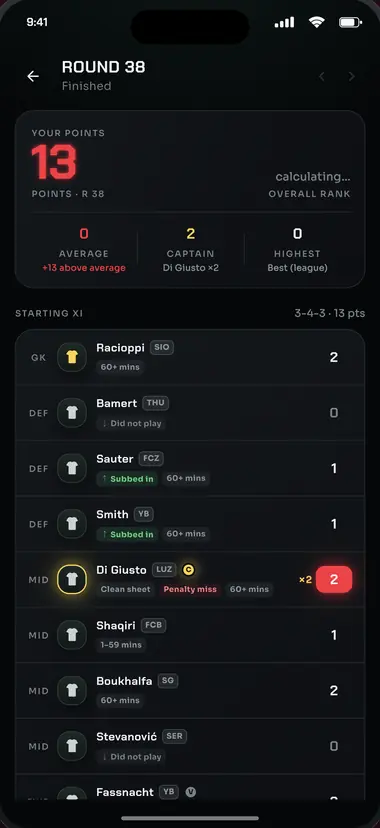
- The captain counts ×2: his whole score for the Round is doubled — bonus points included, and deductions included too.
- With the Triple Captain Boost he counts ×3 instead of ×2.
- If the captain plays 0 minutes and his match is over, the vice counts double instead. As soon as the captain gets so much as a minute he keeps the armband — even if he barely scores.
- The vice only takes over if he played himself. If he is on 0 minutes too and gets replaced by an auto-sub, nobody is doubled that Round — there is no third fallback.
Scoring
Points reward what a player does in the match. For goals and clean sheets the value depends on position: a goalkeeper's goal is worth more than a forward's.
| Action | GK | DEF | MID | FWD |
|---|---|---|---|---|
| Played < 60 min | +1 | +1 | +1 | +1 |
| Played 60+ min | +2 | +2 | +2 | +2 |
| Goal | +6 | +6 | +5 | +4 |
| Assist | +3 | +3 | +3 | +3 |
| Clean sheet (60+ min) | +4 | +4 | +1 | 0 |
| Per 3 saves | +1 | — | — | — |
| Penalty saved | +5 | — | — | — |
| Penalty missed | −2 | −2 | −2 | −2 |
| Per 2 goals conceded | −1 | −1 | — | — |
| Yellow card | −1 | −1 | −1 | −1 |
| Red card | −3 | −3 | −3 | −3 |
| Own goal | −2 | −2 | −2 | −2 |
| Bonus (top 3 in the match) | +3 / +2 / +1 | |||
GK = goalkeeper · DEF = defence · MID = midfield · FWD = attack. “—” means the action is not scored for that position.
The details the table does not show
- 0 minutes is 0 points. A player who never gets on collects neither the appearance point nor any deduction — exactly 0.
- The appearance point is awarded once. Either +1 (under 60 minutes) or +2 (60 minutes or more), never both.
- A clean sheet only counts from 60 minutes. A defender substituted after 45 minutes of a 0-0 gets nothing for it.
- Saves round down. +1 for every complete 3 saves: 3 and 4 saves give +1, 5 saves also +1, 6 saves +2. Goalkeepers only.
- Penalty saved exists only for goalkeepers, while penalty missed costs −2 in any position.
- Goals conceded only punish goalkeepers and defenders, and they round down too: 2 and 3 conceded is −1, 4 conceded is −2. Unlike the clean sheet, minutes played make no difference here. Midfielders and forwards are never penalised for goals conceded.
- Cards and own goals count as often as they happen. A yellow card is −1, a red card is −3.
A player's score for a Round is the sum of these actions plus any bonus points. The captain multiplier is applied only afterwards, to that total.
Bonus points
Every match also hands out +3, +2 and +1 bonus points to its three best performances, judged across both teams. Bonus points are added to the normal score, and they are doubled for the captain along with everything else.
Which three is decided by a separate performance score. It draws on some of the same actions as the points table but weights them differently and more finely — a save registers immediately, where the points table only rewards it from the third one. It also leaves some actions out: a missed penalty costs points, but has no effect at all on the performance score. These values are not points; they exist purely to order the players within one match.
| Action | Value |
|---|---|
| Played 60+ min | +12 |
| Played < 60 min | +6 |
| Goal (goalkeeper / defender) | +36 |
| Goal (midfielder) | +30 |
| Goal (forward) | +24 |
| Assist | +18 |
| Clean sheet (goalkeeper / defender) | +12 |
| Per save | +2 |
| Penalty saved | +15 |
| Per goal conceded (goalkeeper / defender) | −2 |
| Yellow card | −3 |
| Red card | −9 |
| Own goal | −6 |
On how it is awarded:
- Only players with at least one minute played are eligible.
- A player who does not get above zero in that score receives no bonus — not even if hardly anyone played.
- Bonus is not shared. The +3, +2 and +1 go to three different players per match; two players on +3 in the same match does not happen.
Provisional during the Round. Bonus points are provisional. In a tight match the order often flips in the closing minutes — and even after the final whistle the +3 / +2 / +1 are not yet fixed: they become final only when the Round is closed — usually at the next deadline.
Deadline & live points
The game follows the season's calendar: you pick a team for each Round. The deadline is exactly one hour before the Round's first kick-off.
What that means:
- Until then you can change the lineup, the formation, the bench order, the captain, the vice, transfers and Boosts as often as you like.
- After it the Round is locked. Your team for that Round is fixed exactly as it stood at the deadline.
- Anything you change after the deadline automatically applies to the next Round. The Round in play can no longer be influenced — not even by a transfer.
While the matches are on, your score ticks along live. Two things are not yet final during that window: bonus points and auto-subs. Both depend on how the Round's matches turn out, and both can still shift late on.
Closing a Round. Points update live and keep growing with every match. The Round is formally closed at the next deadline — and that is what price changes, your next free transfer and the settlement of any played Boost hang on. We deliberately do not promise a fixed moment from which every single value is final.
Transfers
Once the squad is built, you change it through transfers: one player out, one player in. A transfer always applies to the next Round that is still open and has to be confirmed before that Round's deadline.
Free transfers and the points hit
- You get 1 free transfer per Round.
- Unused free transfers carry over — banked up to a maximum of 5. Beyond that nothing further accumulates.
- Every transfer beyond your free ones costs −4 points. The hit comes off the score of the Round the transfer applies to.
- A new team starts with 1 free transfer.
| Free transfers | Transfers in the Round | Points hit |
|---|---|---|
| 1 | 1 | 0 |
| 1 | 2 | −4 |
| 1 | 3 | −8 |
| 2 | 2 | 0 |
| 2 | 4 | −8 |
| 5 | 6 | −4 |
The next free transfer is credited when a Round is closed, not at the final whistle of its last match.
What counts as a valid transfer
- Position for the same position. Goalkeeper for goalkeeper, defender for defender, midfielder for midfielder, forward for forward. A defender for a midfielder is not possible — your squad always keeps the same 2/5/5/3 split.
- The player you bring in must not already be in your squad.
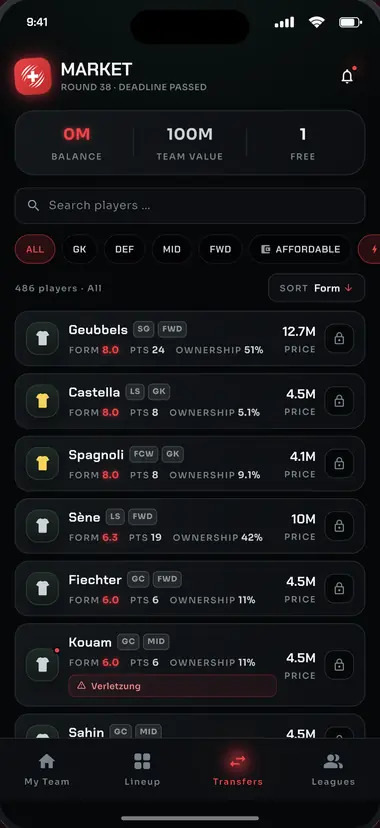
- Your bank cannot go negative. You are credited the selling price of the outgoing player and pay the current price of the incoming one.
- The 3-players-per-club limit must still hold after the transfer.
Prices do not move within a Round in play: they only change at the turn of the Round (see Prices). What the market shows therefore holds for the whole time you are working on that Round.
Boosts
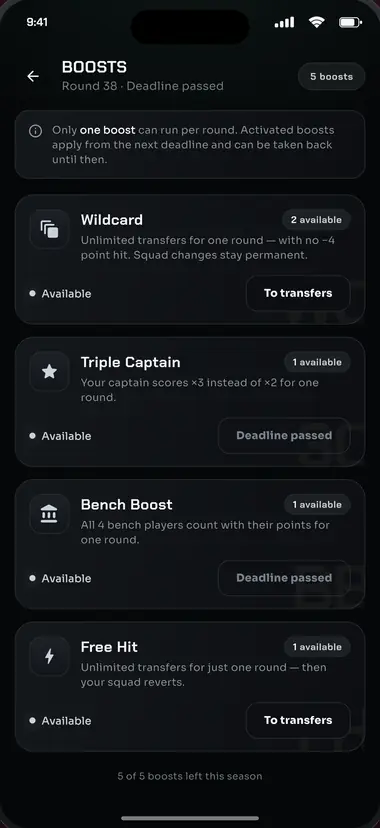
Boosts are one-off trump cards for a single Round. There are four of them, each with a fixed number of uses per season.
| Boost | Per season | Effect |
|---|---|---|
| Wildcard | 2× | Unlimited transfers for one Round — with no −4 point hit. Squad changes stay permanent. |
| Triple Captain | 1× | Your captain scores ×3 instead of ×2 for one Round. |
| Bench Boost | 1× | All 4 bench players count with their points for one Round. |
| Free Hit | 1× | Unlimited transfers for just one Round — then your squad reverts. |
When and how you play a Boost
- Only one Boost can run per Round. Two at once is not possible.
- A Boost always targets the next Round that is still open. You cannot set one aside for a later Round.
- The Wildcard and the Free Hit are played from the transfers flow: you rework the squad and confirm with the Boost. The Triple Captain and the Bench Boost are activated from the Boosts screen.
- The Wildcard and the Free Hit do not use up your banked free transfers. While the Boost is running for that Round, further transfers in the same Round stay free as well.
Taking a Boost back
- The Triple Captain and the Bench Boost can be taken back any time before the deadline, and the use is returned to you.
- The Wildcard and Free Hit can't be taken back once they're confirmed. Their transfers have already been carried out at that moment — and carried out without a points hit.
- Once the Round's deadline has passed, every Boost is final.
Wildcard or Free Hit? Both give you unlimited transfers for one Round with no hit, and neither can be taken back after you confirm. The difference comes afterwards: after the Wildcard you keep the new squad; after the Free Hit you get your old squad back — automatically at the turn of the Round, before the next Round's lineup is locked in. The Wildcard is a rebuild, the Free Hit is a day out.
Prices
Every player starts the season at a list price. From there prices follow performance — getting the squad right early is how you build room for the transfers you want later.
- Prices move after every Round in 0.1M steps, and at most one step per player per Round.
- What drives them is form: score more than your price suggests and you rise; disappoint and you fall. How widely a player is owned makes the move a little faster.
- Prices do not react to live points. They only reflect closed Rounds — until a Round has closed, every player sits at his list price.
- Each Round you get a summary of the price changes among your own players and the players on your watchlist. There is no market-wide list of risers and fallers.
The team value the app shows alongside points and bank is the selling price of every player in your squad added up — your bank is not part of it.
Selling price
Your purchase price is recorded when you buy. What you get back on selling depends on where the price has gone since:
- The price has risen: you get your purchase price plus half the profit, rounded down to whole 0.1M.
- The price has fallen or not moved: you get the current price. The loss is entirely yours.
| Purchase price | Current price | Selling price |
|---|---|---|
| 6.0M | 6.4M | 6.2M |
| 6.0M | 6.5M | 6.2M |
| 6.0M | 6.6M | 6.3M |
| 6.0M | 6.0M | 6.0M |
| 6.0M | 5.7M | 5.7M |
Because the half is rounded down to whole 0.1M, a rise of 0.4M and a rise of 0.5M are worth the same: 0.2M of profit. When you buy a player again, your purchase price is set to the price at that moment.
Form, ownership & FDR
Three figures follow you through almost every decision. They are not rules, but they are precisely defined:
- Form is the average points across the last up-to-four Rounds in which the player has a performance record, to one decimal place. Rounds without a record are skipped — they do not count as zeros.
- Ownership is the share of all teams in the game that have the player in their squad, to one decimal place.
- FDR (Fixture Difficulty Rating) is a difficulty rating from 1 to 5 for a match, derived from the opponent's strength. 1 is easy, 5 is hard. The underlying club strength is written once and not continuously updated afterwards.
Joining mid-season
You can start at any point in the season. Scoring begins with the first Round whose deadline has not yet passed when you create your team. If a Round is already in play, you come in with the next one — you can watch the Round in progress, but it does not score for you. For earlier Rounds you receive no points — not retrospectively either, for players who have already scored heavily. Joining later means starting further back in the overall table, but from your first Round you play under exactly the same rules as everyone else.
Still have questions?
Shorter answers to the most common questions are in our FAQ. The key rules are also available in the app at any time.